

Created by EPSO-EU
It is known that the Kursk Nuclear Power Plant is located in the Russian Federation, 40km to the west of the city of Kursk. It has four RBMK-1000 reactors, which were built between 1976 and 1985. Two of these reactors are definitively shut down.
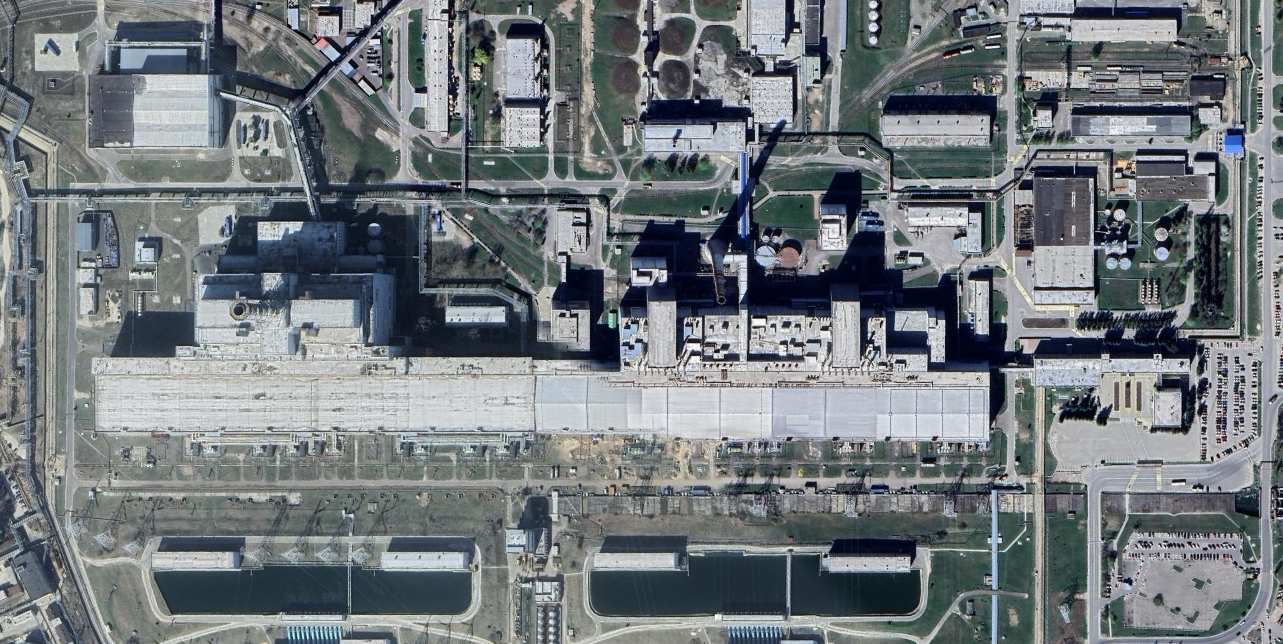
The picture taken by Google Earth application shows us a layout identical to the Chernobyl plant. Four units aligned to a huge common turbine building of about 700m, sharing ventilation chimney two to two units, and an industrial area where common services to the four units are located, as well as their emergency diesel generators. We observe essential cooling ponds and a large lake that has to be the ultimate heat sink, as no cooling towers are observed.
RBMK reactors are cooled by boiling water and moderated by graphite. These series of reactors were developed by the USSR in the 1950’s and were deployed in several locations, as well as exported to several countries. As part of the RBMK series, there are several models, particularly characterized by their power. RBMK models were designed to be recharged while running with the help of complex replenishment systems. This makes them suitable for a plutonium production program, as they can combine both isotope and electricity production.
In this area, this kind of model is considered dangerous and, of course, obsolete. Following the accident, the Russians have implemented numerous design and operation modifications, so that the catastrophe does not happen again, and have kept them running for many years. However, they have not continued building them. They have been replaced by the local version of the pressurized water reactor called the VVER.
The crucial difference between the RBMK type and Western model plants lies in the fact that the RBMK are not surrounded by a containment building. A containment building that is built following Western regulations is designed to withstand the largest accident on a reactor that can be rationally imagined. This would involve a guillotine break of the largest coolant piping of the reactor, running at 100% power. As the primary system works at 150 atmospheres, this would mean a huge steam explosion. In order for our containment buildings to endure this explosion, they are made up of high performance and extremely thick reinforced concrete.
Obviously, not all points of a nuclear facility are equally important in the face of a possible military aggression. The most sensitive one is the building of the reactor itself.
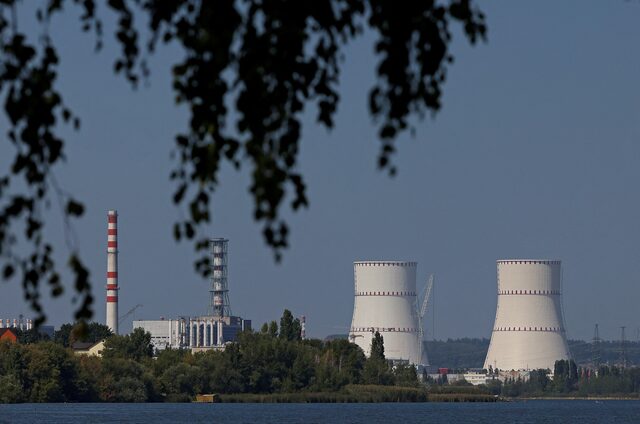
If a direct and repeated attack with piercing ammunition is launched vertically against the reactors, while they are running, it might cause significant damage to the reactor cover and its pressure tubes, depressurize the system, as well as trigger a coolant loss and the immediate release of very significant amounts of radioactive material.
Precision is required in this kind of attack. The weapon used should have a Circular Error Probable of less than ther reactor diameter, which is 11.8m. Using the right angle is also required, as an attack launched from above is not the same as from one side.
A less sophisticated attack against support infrastructures, such as internal electricity distribution (transformers)or external electricity distribution (lines), emergency diesel generators, emergency cooling pools or spent fuel ponds may lead to an emergency situation but whether it results in significant release is uncertain.
We cannot rule out the possibility that someone might infiltrate the plant to cause damage from within. Putting the plant out of service is an option, since there are many systems that have to be aligned and in operation in order for the plant to be operational.
This first threat mentioned (a direct attack) could lead to a catastrophic release of radioactivity. The amount of radioactivity released in the Chernobyl accident would be the ultimate limit. The key issue here is whether the graphite ignites or not. Once the radioactive material is released into the atmosphere, local weather conditions will determine whether the material will be swept by the wind. The radioactive cloud would potentially affect the whole Europe.
As for the second threat mentioned (an indirect attack), a local emergency situation could happen, but a massive release of radioactive material is unlikely to occur. The plant would be out of service for a long period of time.
The third threat mentioned (sabotage) could also put the plant out of service for a rather long period, but it is unlikely to generate a significant release.
Any party involved in the conflict that causes a significant release, directly or indirectly, of radioactive material in this or any other nuclear power plant will face very strong internal opposition among the local population, as well as external confrontation.
No responses yet