

1.- BACKGROUND INFORMATION
The Bushehr Nuclear Power Plant (BNPP) is located in the territory of the Islamic Republic of Iran, some 20 kilometres away from the city of Bushehr, on the shores of the Gulf.
The available information in the PRIS of the IAEA reveals that it is a plant with two units of pressurized water; one of them is operational. The latter is a VVER-446 model, with 3000 MW thermal power, 1000 MW electric power. It started producing energy in 2011.
2.- HISTORY OF THE PROJECT
The project began in 1975, following an agreement between Iran and the Federal Republic of Germany, whereby the latter would deliver the former a nuclear power plant with two reactors, supplied by the company Kraftwerk Union AG, known as KWU.
The reactors are the German version of the pressurized water reactor (PWR). They have very few differences with other PWRs, that is, initially we are talking about systems completely assimilated to the Western ones.
In 1979, due to the triumph of the Islamic Revolution in Iran, the project was cancelled, payments were suspended and the KWU personnel withdrew, leaving the Unit 1 project at 85% and Unit 2 project at 50%.
During the Iran-Iraq war, the nuclear power plant was attacked several times, between March 1984 and November 1987.
In 1992, contacts between Iran and Russia began in order to complete the project. In 1995, a contract was signed for this purpose, but there were technical and economic difficulties.
A revised agreement was signed in 2006, which provides for the installation of a Russian model inside the containment building already constructed. The supplier is now the Russian company Atomstroyexport and the reactor is a VVER-446 model, very different from the original KWU.
In 2010, the plant was completed and nuclear fuel loading began. On 8 May 2011, Unit 1 achieved criticality and on 3 September it was connected to the Iranian electricity grid.
It is worth noting that the Russian-Iranian contract provides that the nuclear fuel of the plant is supplied by Russia, and must return there once used. It is subject to safeguards and it is supervised by the IAEA, both at origin and at destination. In this way, it cannot be used by Iran to reprocess it and access the plutonium contained in this used fuel.
The degree of enrichment is 3.62%. It is likely taken to Russia by rail and sea transport.
3.- KWU TECHNOLOGY
KWU pressurized water reactors are very similar to the Westinghouse type. Among other aspects, some technical details of the steam generators differ: the German ones do not have penetrations in the lower part of the vessel and the American do; also, the KWU containment building is accessible to power whereas access to containment in American models is very limited.
Another important difference is that KWU models have an electronic monitoring system for technical parameters – called “limitation system” – which detects in a very fast and effective manner any significant change in technical parameters, before the Reactor Protection System takes action.
This last system is installed in all power reactors, all models. It is responsible for initiating the emergency stop of the reactor and other automatic actions, such as the start of the safety injection, the start of the emergency diesel generators or initiating the insulation of the containment building.
Please find a diagram of a KWU containment below:
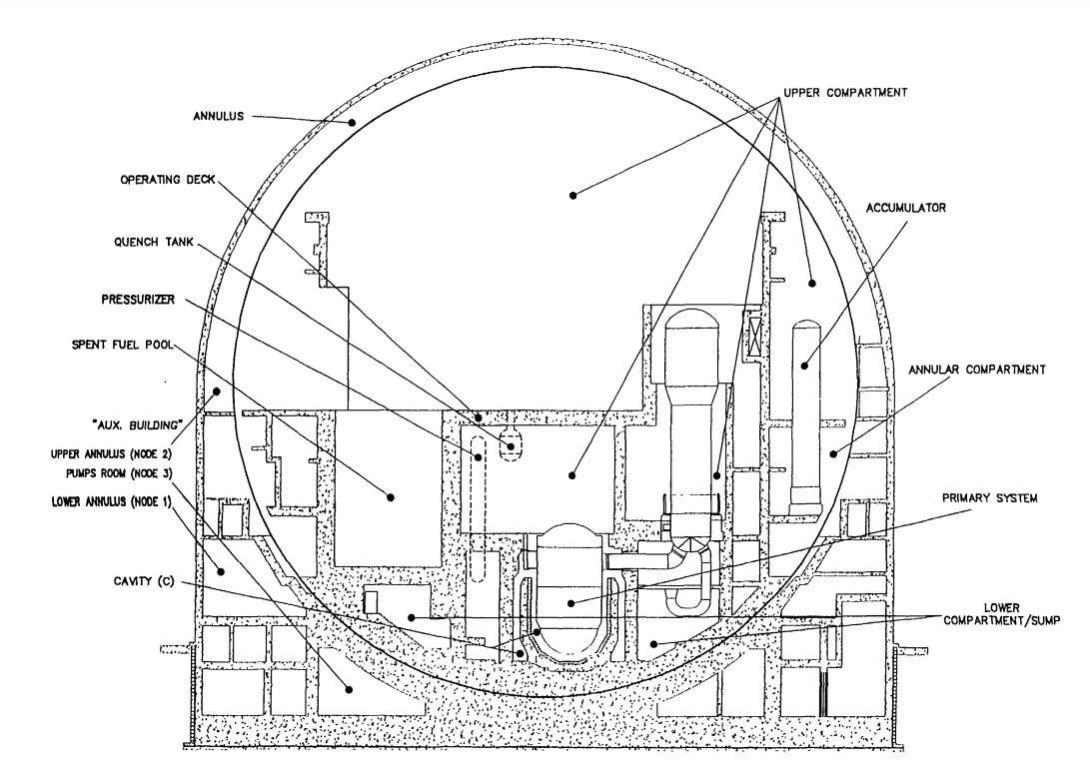
It can be seen that the containment system is double, a steel sphere surrounded by a concrete building whose thickness ranges between 1 and 1.5m. The steel sphere is the containment itself, with a design pressure of 5’38 bar. The concrete building is designed to provide extra shielding against accidents of external nature and to maintain a separate atmosphere that helps prevent radioactive material from leaking in case of an accident.
4.- VVER TECHNOLOGY
VVER reactors are the Russian version of PWRs, pressurized water reactors. The Russian had expertise on this technology as they used it for their submarines. It must be said that miniaturized PWRs – suitable for submarines – require high (and therefore expensive) fuel enrichment. For many years, Russia used RBMK technology for its civilian plants, but even before the Chernobyl accident, they stopped building RBMKs to focus on VVER models.
When comparing VVERs and western PWRs, the vessel of the Russian reactor has a smaller diameter, with inlet and outlet nozzles of each coolant loop overlapped, instead of radially distributed. Reducing the diameter seems to be aimed at facilitating the transport of the reactor vessel by train. Another difference is that Russian steam generators are arranged horizontally rather than vertically. Containments depend on the generation of the reactor, but all of them (generally speaking) are as robust as their western counterparts. Fuel elements are hexagonal instead of quadrangular.
This is the diagram of the primary system of a cutting-edge VVER:
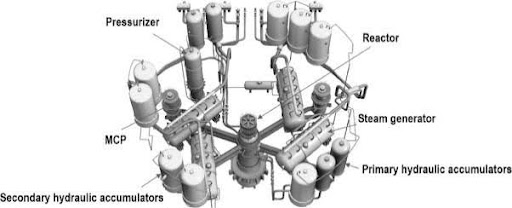
This image can help us appreciate how special this project is. The point is to assemble a similar system – not identical – inside a containment building like the one seen in the previous image.
5.- VISUAL INFORMATION AVAILABLE
Google Earth shows this image of the Bushehr Nuclear Power Plant:
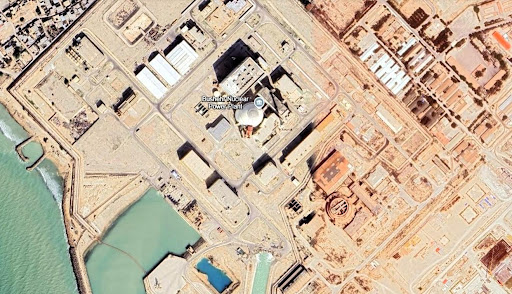
The picture above shows the standard layout of KWU power plants. The red object attached to the containment (in white) is the so-called Gantry crane, which can place heavy elements, such as the reactor vessel or steam generators, inside the containment. It also removes containers of used fuel from the containment.
We can see the water intake structure, probably shared by the two units, the discharge channel with signs of water foam that indicates that circulation pumps are running; this means that the plant is very likely operational. This intake and discharge structure make cooling towers unnecessary.
Concerning the picture of Unit 1, we can see down the emergency diesel building and emergency feed-water system for steam generators, the turbine building, the electrical building and the auxiliary building.
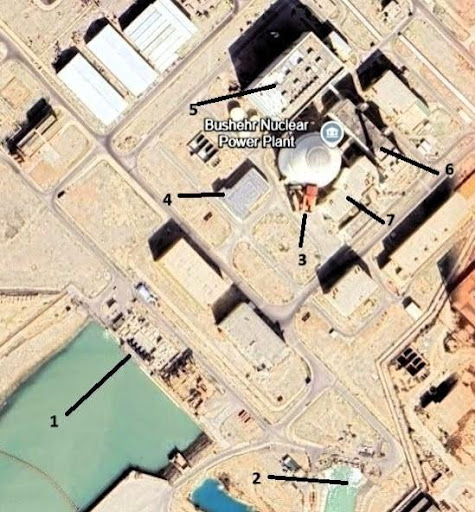
1. Water intake structure
2. Discharge channel
3. Containment building
4. Emergency diesel building
5. Turbine building
6. Electrical building
7. Auxiliary building
The main transformers are not seen in the picture. They are probably located in the building next to the turbine building in order to be protected against potential drone attacks.
The image of Unit 2 is very interesting because it allow us to see the inside of a half-built KWU containment. It is like the diagram in Figure 2 but seen from above: the polar crane and the two parts of the containment (inside and outside) can be seen. A high compartmentalization in concrete can be seen; the fuel pool can be guessed and the reactor cavity is hardly distinguished.
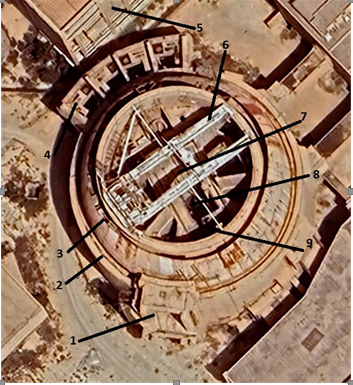
1. Access door (Gantry crane missing)
2. Containment concrete Shell
3. Metal containment
4. Valve hall
5. Turbine building
6. Polar crane
7. Reactor cavity
8. Intermediate cavity
9. Fuel pool
6.- RISK ANALYSIS
Location-related risks
The first consideration is the geographical location of the project. On the shore of the Persian Gulf, the project will be much more exposed to naval armament. There are more weapons that could reach it, and many countries have vessels with the possibility to carry those weapons. History knows it that foe weapons have already affected this plant. Exactly the same type of location affects the ultra modern plant in Barakah, with four 1,400MWe units, recently built on the other bank of the Gulf, in the United Arab Emirates, around 555km away.
Intrinsic Risks
By intrinsic risks, we refer to risks intrinsic to the plant. Assessing the risks of commercial nuclear plants requires two parameters: a) probability of damaging the reactor core and b) probability of a large release. Those data are measured using probabilistic risk assessment tools. When talking about “damage to the reactor core”, we actually refer to the “catastrophic destruction of a large part of the reactor core”, or “fusion of a significant part”. It is estimated that, out of ten times a meltdown happens, one will be a failure of the containment building, and will result in releasing large quantities of radioactive material —something that has, unfortunately, happened at some point.
Probability of damaging the reactor core of a VVER plant of this generation is similar to that of Western nuclear power plants. This probability for the model we are referring to is minimum 1.5 x 10⁻⁵ fusions/year. This probability, 0.000015, means that for the hypothetical meltdown of a single reactor core, we would need 70,000 reactors of this model working at full capacity, and only after a sequence of internal failures whose probability is known.
According to this study, probability of large radioactivity releases, after the reactor core fusion, is ten times lower.
Thus, a simple and short answer to the question: how safe is Busher-1 nuclear power plant? The answer is: It is as safe as any Western second generation nuclear plant.
Risks in case of a military attack
In the case a country decided to attack this plant, it would be very different from attacking an old RBMK-type nuclear power plant of the times of Chernobyl —that is history. In these days there is a robust KWU containment that the missile had to perforate to reach the reactor or a component of the primary circuit, steam generators, or pressurizers. If a saturation attack with penetrating ammunition on the reactor shaft takes place, a catastrophic liberation of radioactive material can be expected.
With the power of that reactor, if we make a rule of three with what was released from Fukushima-1, we could assess that the maximum radioactivity of Cs-137 released would be inferior to 6,400 TBq —around 0.3 times that from Fukushima. This is so because in Fukushima four reactor cores melt down and 4 containments were destroyed; the 4 reactors totalled 2,818 MW power.
That hypothetical radioactive release would create a radioactive cloud that would drift in the skies over the Persian Gulf, depending on the wind; it would be as unpredictable as the wind.
If the attack is on a support building, the radioactive release would be much lower —around a thousand times lower. In this case, the sensitive point would be the services building. It houses many radioactive water tanks.
We cannot tell a priori, but among the neighbouring buildings there must be one for dry storage of used fuel; this is another sensitive point.
As for KWU models, the used fuel pool is inside the containment. It seems to have maintained this feature typical of the German nuclear power plants. This means that this sensitive point would be as well protected as the reactor core itself.
It is much easier to put the nuclear power plant out of work, to force it to stop producing electricity. There are many more sensitive points: the substation, the high voltage pylons, the intake structure, and the turbine building. Besides, there are other technologies available. We cannot rule out cyber attacks using malicious software.
No responses yet